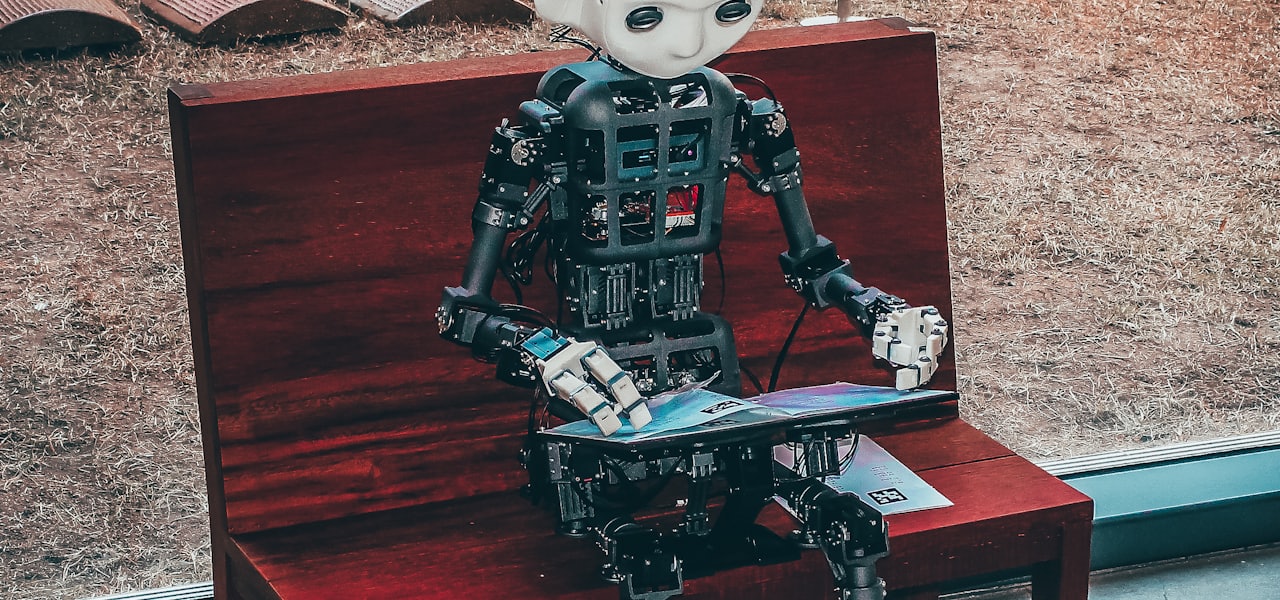
The following outline is provided as an overview of and topical guide to artificial intelligence: Artificial intelligence (AI) is intelligence exhibited by machines or software. It is also the name of the scientific field which studies how to create computers and computer software that are capable of intelligent behavior. == AI terminology == Glossary of artificial intelligence == Goals and applications == === General intelligence === Artificial general intelligence AI-complete === Reasoning and problem solving === Automated reasoning Mathematics Automated theorem prover Computer-assisted proof – Computer algebra General Problem Solver Expert system – Decision support system – Clinical decision support system – === Knowledge representation === Knowledge representation Knowledge management Cyc === Planning === Automated planning and scheduling Strategic planning Sussman anomaly – === Learning === Machine learning – Constrained Conditional Models – Deep learning – Neural modeling fields – Supervised learning – Weak supervision (semi-supervised learning) – Unsupervised learning – === Natural language processing === Natural language processing (outline) – Chatterbots – Language identification – Large language model – Retrieval-augmented generation – Natural language user interface – Natural language understanding – Machine translation – Statistical semantics – Question answering – Semantic translation – Concept mining – Data mining – Text mining – Process mining – E-mail spam filtering – Information extraction – Named-entity extraction – Coreference resolution – Named-entity recognition – Relationship extraction – Terminology extraction – === Perception === Machine perception Pattern recognition – Computer Audition – Speech recognition – Speaker recognition – Computer vision (outline) – Image processing Intelligent word recognition – Object recognition – Optical mark recognition – Handwriting recognition – Optical character recognition – Automatic number plate recognition – Information extraction – Image retrieval – Automatic image annotation – Facial recognition systems – Silent speech interface – Activity recognition – Percept (artificial intelligence) === Robotics === Robotics – Behavior-based robotics – Cognitive – Cybernetics – Developmental robotics – Evolutionary robotics – === Control === Intelligent control Self-management (computer science) – Autonomic Computing – Autonomic Networking – === Social intelligence === Affective computing Kismet === Game playing === Game artificial intelligence – Computer game bot – computer replacement for human players. Video game AI – Computer chess – Computer Go – General game playing – General video game playing – === Creativity, art and entertainment === Artificial creativity Artificial life Artificial intelligence art AI anthropomorphism AI agent AI web browser AI boom AI slop Creative computing Generative artificial intelligence Generative pre trained transformer Uncanny valley Music and artificial intelligence Computational humor Chatbot === Integrated AI systems === AIBO – Sony's robot dog. It integrates vision, hearing and motorskills. Asimo (2000 to present) – humanoid robot developed by Honda, capable of walking, running, negotiating through pedestrian traffic, climbing and descending stairs, recognizing speech commands and the faces of specific individuals, among a growing set of capabilities. MIRAGE – A.I. embodied humanoid in an augmented reality environment. Cog – M.I.T. humanoid robot project under the direction of Rodney Brooks. QRIO – Sony's version of a humanoid robot. TOPIO, TOSY's humanoid robot that can play ping-pong with humans. Watson (2011) – computer developed by IBM that played and won the game show Jeopardy! It is now being used to guide nurses in medical procedures. Purpose: Open domain question answering Technologies employed: Natural language processing Information retrieval Knowledge representation Automated reasoning Machine learning Project Debater (2018) – artificially intelligent computer system, designed to make coherent arguments, developed at IBM's lab in Haifa, Israel. === Intelligent personal assistants === Intelligent personal assistant – Amazon Alexa – Assistant – Braina – Cortana – Google Assistant – Google Now – Mycroft – Siri – Viv – === Other applications === Artificial life – simulation of natural life through the means of computers, robotics, or biochemistry. Automatic target recognition – Diagnosis (artificial intelligence) – Speech generating device – Vehicle infrastructure integration – Virtual Intelligence – == History == History of artificial intelligence Progress in artificial intelligence Timeline of artificial intelligence AI effect – as soon as AI successfully solves a problem, the problem is no longer considered by the public to be a part of AI. This phenomenon has occurred in relation to every AI application produced, so far, throughout the history of development of AI. AI winter – a period of disappointment and funding reductions occurring after a wave of high expectations and funding in AI. Such funding cuts occurred in the 1970s, for instance. Moore's law === History by period === 2017 in artificial intelligence 2018 in artificial intelligence 2019 in artificial intelligence 2020 in artificial intelligence 2021 in artificial intelligence 2022 in artificial intelligence 2023 in artificial intelligence 2024 in artificial intelligence 2025 in artificial intelligence 2026 in artificial intelligence 2027 in artificial intelligence 2028 in artificial intelligence 2029 in artificial intelligence === History by subject === History of logic (formal reasoning is an important precursor of AI) History of machine learning (timeline) History of machine translation (timeline) History of natural language processing History of optical character recognition (timeline) == AI algorithms and techniques == === Search === Discrete search algorithms Uninformed search Brute force search – Problem-solving technique and algorithmic paradigmPages displaying short descriptions of redirect targets Search tree – Data structure in tree form sorted for fast lookup Breadth-first search – Algorithm to search the nodes of a graph Depth-first search – Algorithm to search the nodes of a graph State space search – Class of search algorithmsPages displaying short descriptions of redirect targets Informed search Best-first search – Graph exploring search algorithm A search algorithm – Algorithm used for pathfinding and graph traversal Heuristics – Problem-solving methodPages displaying short descriptions of redirect targets Pruning (algorithm) – Data compression techniquePages displaying short descriptions of redirect targets Adversarial search Minmax algorithm – Decision rule used for minimizing the possible loss for a worst-case scenarioPages displaying short descriptions of redirect targets Logic as search Production system (computer science) – Computer program used to provide artificial intelligence Rule based system – Type of computer systemPages displaying short descriptions of redirect targets Production rule – Computer program used to provide artificial intelligence Inference rule – Method of deriving conclusionsPages displaying short descriptions of redirect targets Horn clause – Type of logical formula Forward chaining – Inference engine in an expert system Backward chaining – Method of forming inferences Planning as search State space search – Class of search algorithmsPages displaying short descriptions of redirect targets Means–ends analysis – Problem solving technique === Optimization search === Optimization (mathematics) algorithms Hill climbing – Optimization algorithm Simulated annealing – Probabilistic optimization technique and metaheuristic Beam search – Heuristic search algorithm Random optimization – Optimization technique in mathematics Evolutionary computation Genetic algorithms – Competitive algorithm for searching a problem spacePages displaying short descriptions of redirect targets Gene expression programming – Evolutionary algorithm Genetic programming – Evolving computer programs with techniques analogous to natural genetic processes Differential evolution – Method of mathematical optimization Society based learning algorithms. Swarm intelligence – Collective behavior of decentralized, self-organized systems Particle swarm optimization – Iterative simulation method Ant colony optimization – Optimization algorithmPages displaying short descriptions of redirect targets Metaheuristic – Optimization technique === Logic === Logic and automated reasoning Programming using logic Logic programming – Programming paradigm based on formal logic See "Logic as search" above. Forms of Logic Propositional logic First-order logic First-order logic with equality Constraint satisfaction – Process in artificial intelligence and operations research Fuzzy logic Fuzzy set theory – Sets whose elements have degrees of membershipPages displaying short descriptions
Thunderspy
Thunderspy is a type of security vulnerability, based on the Intel Thunderbolt 3 port, first reported publicly on 10 May 2020, that can result in an evil maid (i.e., attacker of an unattended device) attack gaining full access to a computer's information in about five minutes, and may affect millions of Apple, Linux and Windows computers, as well as any computers manufactured before 2019, and some after that. According to Björn Ruytenberg, the discoverer of the vulnerability, "All the evil maid needs to do is unscrew the backplate, attach a device momentarily, reprogram the firmware, reattach the backplate, and the evil maid gets full access to the laptop. All of this can be done in under five minutes." The malicious firmware is used to clone device identities which makes classical DMA attack possible. == History == The Thunderspy security vulnerabilities were first publicly reported by Björn Ruytenberg of Eindhoven University of Technology in the Netherlands on 10 May 2020. Thunderspy is similar to Thunderclap, another security vulnerability, reported in 2019, that also involves access to computer files through the Thunderbolt port. == Impact == The security vulnerability affects millions of Apple, Linux and Windows computers, as well as all computers manufactured before 2019, and some after that. However, this impact is restricted mainly to how precise a bad actor would have to be to execute the attack. Physical access to a machine with a vulnerable Thunderbolt controller is necessary, as well as a writable ROM chip for the Thunderbolt controller's firmware. Additionally, part of Thunderspy, specifically the portion involving re-writing the firmware of the controller, requires the device to be in sleep, or at least in some sort of powered-on state, to be effective. Machines that force power-off when the case is open may assist in resisting this attack to the extent that the feature (switch) itself resists tampering. Due to the nature of attacks that require extended physical access to hardware, it's unlikely the attack will affect users outside of a business or government environment. == Mitigation == The researchers claim there is no easy software solution, and may only be mitigated by disabling the Thunderbolt port altogether. However, the impacts of this attack (reading kernel level memory without the machine needing to be powered off) are largely mitigated by anti-intrusion features provided by many business machines. Intel claims enabling such features would substantially restrict the effectiveness of the attack. Microsoft's official security recommendations recommend disabling sleep mode while using BitLocker. Using hibernation in place of sleep mode turns the device off, mitigating potential risks of attack on encrypted data.
Purged cross-validation
Purged cross-validation is a variant of k-fold cross-validation designed to prevent look-ahead bias in time series and other structured data, developed in 2017 by Marcos López de Prado at Guggenheim Partners and Cornell University. It is primarily used in financial machine learning to ensure the independence of training and testing samples when labels depend on future events. It provides an alternative to conventional cross-validation and walk-forward backtesting methods, which often yield overly optimistic performance estimates due to information leakage and overfitting. == Motivation == Standard cross-validation assumes that observations are independently and identically distributed (IID), which often does not hold in time series or financial datasets. If the label of a test sample overlaps in time with the features or labels in the training set, the result may be data leakage and overfitting. Purged cross-validation addresses this issue by removing overlapping observations and, optionally, adding a temporal buffer ("embargo") around the test set to further reduce the risk of leakage. The figure below illustrates standard 5 Fold Cross-Validation == Purging == Purging removes from the training set any observation whose timestamp falls within the time range of formation of a label in the test set. This can be the case for train set observations before and after the test set. Their removal ensures that the algorithm cannot learn during train time information that will be used to assess the performance of the algorithm. See the figure below for an illustration of purging. == Embargoing == Embargoing addresses a more subtle form of leakage: even if an observation does not directly overlap the test set, it may still be affected by test events due to market reaction lag or downstream dependencies. To guard against this, a percentage-based embargo is imposed after each test fold. For example, with a 5% embargo and 1000 observations, the 50 observations following each test fold are excluded from training. Unlike purging, embargoing can only occur after the test set. The figure below illustrates the application of embargo: == Applications == Purged and embargoed cross-validation has been useful in: Backtesting of trading strategies Validation of classifiers on labeled event-driven returns Any machine learning task with overlapping label horizons == Example == To illustrate the effect of purging and embargoing, consider the figures below. Both diagrams show the structure of 5-fold cross-validation over a 20-day period. In each row, blue squares indicate training samples and red squares denote test samples. Each label is defined based on the value of the next two observations, hence creating an overlap. If this overlap is left untreated, test set information leaks into the train set. The second figure applies the Purged CV procedure. Notice how purging removes overlapping observations from the training set and the embargo widens the gap between test and training data. This approach ensures that the evaluation more closely resembles a true out-of-sample test and reduces the risk of backtest overfitting. == Combinatorial Purged Cross-Validation == Walk-forward backtesting analysis, another common cross-validation technique in finance, preserves temporal order but evaluates the model on a single sequence of test sets. This leads to high variance in performance estimation, as results are contingent on a specific historical path. Combinatorial Purged Cross-Validation (CPCV) addresses this limitation by systematically constructing multiple train-test splits, purging overlapping samples, and enforcing an embargo period to prevent information leakage. The result is a distribution of out-of-sample performance estimates, enabling robust statistical inference and more realistic assessment of a model's predictive power. === Methodology === CPCV divides a time-series dataset into N sequential, non-overlapping groups. These groups preserve the temporal order of observations. Then, all combinations of k groups (where k < N) are selected as test sets, with the remaining N − k groups used for training. For each combination, the model is trained and evaluated under strict controls to prevent leakage. To eliminate potential contamination between training and test sets, CPCV introduces two additional mechanisms: Purging: Any training observations whose label horizon overlaps with the test period are excluded. This ensures that future information does not influence model training. Embargoing: After the end of each test period, a fixed number of observations (typically a small percentage) are removed from the training set. This prevents leakage due to delayed market reactions or auto-correlated features. Each data point appears in multiple test sets across different combinations. Because test groups are drawn combinatorially, this process produces multiple backtest "paths," each of which simulates a plausible market scenario. From these paths, practitioners can compute a distribution of performance statistics such as the Sharpe ratio, drawdown, or classification accuracy. === Formal definition === Let N be the number of sequential groups into which the dataset is divided, and let k be the number of groups selected as the test set for each split. Then: The number of unique train-test combinations is given by the binomial coefficient: ( N k ) {\displaystyle {\binom {N}{k}}} Each observation is used in k {\displaystyle k} test sets and contributes to φ [ N , k ] {\displaystyle \varphi [N,k]} unique backtest paths: φ [ N , k ] = k N ( N k ) {\displaystyle \varphi [N,k]={\frac {k}{N}}{\binom {N}{k}}} This yields a distribution of performance metrics rather than a single point estimate, making it possible to apply Monte Carlo-based or probabilistic techniques to assess model robustness. === Illustrative example === Consider the case where N = 6 and k = 2. The number of possible test set combinations is ( 6 2 ) = 15 {\displaystyle {\binom {6}{2}}=15} . Each of the six groups appears in five test splits. Consequently, five distinct backtest paths can be constructed, each incorporating one appearance from every group. ==== Test group assignment matrix ==== This table shows the 15 test combinations. An "x" indicates that the corresponding group is included in the test set for that split. ==== Backtest path assignment ==== Each group contributes to five different backtest paths. The number in each cell indicates the path to which the group's result is assigned for that split. === Advantages === Combinatorial Purged Cross-Validation offers several key benefits over conventional methods: It produces a distribution of performance metrics, enabling more rigorous statistical inference. The method systematically eliminates lookahead bias through purging and embargoing. By simulating multiple historical scenarios, it reduces the dependence on any single market regime or realization. It supports high-confidence comparisons between competing models or strategies. CPCV is commonly used in quantitative strategy research, especially for evaluating predictive models such as classifiers, regressors, and portfolio optimizers. It has been applied to estimate realistic Sharpe ratios, assess the risk of overfitting, and support the use of statistical tools such as the Deflated Sharpe Ratio (DSR). === Limitations === The main limitation of CPCV stems from its high computational cost. However, this cost can be managed by sampling a finite number of splits from the space of all possible combinations.
.ai
.ai is the Internet country code top-level domain (ccTLD) for Anguilla, a British Overseas Territory in the Caribbean. It is administered by the government of Anguilla. It is a popular domain hack with companies and projects related to the artificial intelligence industry (AI). Google's ad targeting treats .ai as a generic top-level domain (gTLD) because "users and website owners frequently see [the domain] as being more generic than country-targeted." In 2021, Google Search analyst Gary Illyes announced that ".ai" had been added to Google’s list of generic country-code top-level domains, meaning that Google would no longer infer Anguilla-specific targeting from the ccTLD. Identity Digital began managing the domain as of January 2025. == Second and third level registrations == Registrations within off.ai, com.ai, net.ai, and org.ai are available worldwide without restriction. From 15 September 2009, second level registrations within .ai are available to everyone worldwide. == Registration == The minimum registration term allowed for .ai domains is 2 through 10 years for registration and renewal, and a 2-year renewal for domain transfer. Identity Digital is the authority in charge of managing this extension. Registrations began on 16 February 1995. The limits on the number of characters used for the domain name are, at a minimum, from 1 to 3, depending on the registrar, and always at most 63 characters. The character set supported for .ai domain names includes A–Z, a–z, 0–9, and hyphen. As of November 2022, .ai domains cannot accommodate IDN characters. There are no requirements for registering a domain, including local and foreign residents. A .ai domain can be suspended or revoked, if the domain is involved in illegal activity such as violating trademarks or copyrights. Usage must not violate the laws of Anguilla. Anguilla uses the UDRP. Filing a UDRP challenge requires using one of the ICANN Approved Dispute Resolution Service Providers. If the domain is with an ICANN accredited registrar, they should work with the arbitrator. Usually this means either doing nothing or transferring a domain. .ai domains are transferable to any desired registrars as the registration of domain is done maintaining EPP. There used to be a whois.ai-based platform of expired domains in which those could be procured and auctioned every ten days through a standard online process. The last auctions of such kind closed there in December 2024; the platform had been scheduled for shutdown on 30 June 2025, but remained online in the months following that date. == Valuation == Domains cost depends on the registrar, with yearly fees ranging from US$140 (the base fee, as established by Anguilla) to $200. As of July 2025, the highest-valued .ai domain is an undisclosed one sold on 8 November 2023, on Escrow.com, for US$1,500,000—months after an initial $300,000 sale to the same buyer. Among the publicly disclosed ones, the most valued, fin.ai, was sold for $1,000,000 in March 2025. On 16 December 2017, the .ai registry started supporting the Extensible Provisioning Protocol (EPP) and migrated all of its domains onto an EPP system. Consequently, many registrars are allowed to sell .ai domains. Since that date, the .ai ccTLD has also been popular with artificial intelligence companies and organisations. Though such trends are primarily seen among new AI based companies or startups, many established AI and Tech companies preferred not to opt for .ai domains. For example, DeepMind has its domain retained at .com; Meta has redirected its facebook.ai domain to ai.meta.com. == Impact on Anguilla's economy == The registration fees earned from the .ai domains go to the treasury of the Government of Anguilla. As per a 2018 New York Times report, the total revenue generated out of selling .ai domains was $2.9 million. In 2023, Anguilla's government made about US$32 million from fees collected for registering .ai domains; that amounted to over 10% of gross domestic product for the territory. "In the years before the real breakthrough of AI, revenue from .ai domains made up less than 1% of our state income, by 2025 it will be around 47%," explained Jose Vanterpool, Minister of Infrastructure and Communications (MICUHITES), in an interview with BBC. The high 90% renewal rate of .ai domains and the 2025 renewal wave of domains registered in 2023 are driving another surge in state revenues, according to Domaintechnik.
Highway network
In machine learning, the Highway Network was the first working very deep feedforward neural network with hundreds of layers, much deeper than previous neural networks. It uses skip connections modulated by learned gating mechanisms to regulate information flow, inspired by long short-term memory (LSTM) recurrent neural networks. The advantage of the Highway Network over other deep learning architectures is its ability to overcome or partially prevent the vanishing gradient problem, thus improving its optimization. Gating mechanisms are used to facilitate information flow across the many layers ("information highways"). Highway Networks have found use in text sequence labeling and speech recognition tasks. In 2014, the state of the art was training deep neural networks with 20 to 30 layers. Stacking too many layers led to a steep reduction in training accuracy, known as the "degradation" problem. In 2015, two techniques were developed to train such networks: the Highway Network (published in May), and the residual neural network, or ResNet (December). ResNet behaves like an open-gated Highway Net. == Model == The model has two gates in addition to the H ( W H , x ) {\displaystyle H(W_{H},x)} gate: the transform gate T ( W T , x ) {\displaystyle T(W_{T},x)} and the carry gate C ( W C , x ) {\displaystyle C(W_{C},x)} . The latter two gates are non-linear transfer functions (specifically sigmoid by convention). The function H {\displaystyle H} can be any desired transfer function. The carry gate is defined as: C ( W C , x ) = 1 − T ( W T , x ) {\displaystyle C(W_{C},x)=1-T(W_{T},x)} while the transform gate is just a gate with a sigmoid transfer function. == Structure == The structure of a hidden layer in the Highway Network follows the equation: y = H ( x , W H ) ⋅ T ( x , W T ) + x ⋅ C ( x , W C ) = H ( x , W H ) ⋅ T ( x , W T ) + x ⋅ ( 1 − T ( x , W T ) ) {\displaystyle {\begin{aligned}y=H(x,W_{H})\cdot T(x,W_{T})+x\cdot C(x,W_{C})\\=H(x,W_{H})\cdot T(x,W_{T})+x\cdot (1-T(x,W_{T}))\end{aligned}}} == Related work == Sepp Hochreiter analyzed the vanishing gradient problem in 1991 and attributed to it the reason why deep learning did not work well. To overcome this problem, Long Short-Term Memory (LSTM) recurrent neural networks have residual connections with a weight of 1.0 in every LSTM cell (called the constant error carrousel) to compute y t + 1 = F ( x t ) + x t {\textstyle y_{t+1}=F(x_{t})+x_{t}} . During backpropagation through time, this becomes the residual formula y = F ( x ) + x {\textstyle y=F(x)+x} for feedforward neural networks. This enables training very deep recurrent neural networks with a very long time span t. A later LSTM version published in 2000 modulates the identity LSTM connections by so-called "forget gates" such that their weights are not fixed to 1.0 but can be learned. In experiments, the forget gates were initialized with positive bias weights, thus being opened, addressing the vanishing gradient problem. As long as the forget gates of the 2000 LSTM are open, it behaves like the 1997 LSTM. The Highway Network of May 2015 applies these principles to feedforward neural networks. It was reported to be "the first very deep feedforward network with hundreds of layers". It is like a 2000 LSTM with forget gates unfolded in time, while the later Residual Nets have no equivalent of forget gates and are like the unfolded original 1997 LSTM. If the skip connections in Highway Networks are "without gates," or if their gates are kept open (activation 1.0), they become Residual Networks. The residual connection is a special case of the "short-cut connection" or "skip connection" by Rosenblatt (1961) and Lang & Witbrock (1988) which has the form x ↦ F ( x ) + A x {\displaystyle x\mapsto F(x)+Ax} . Here the randomly initialized weight matrix A does not have to be the identity mapping. Every residual connection is a skip connection, but almost all skip connections are not residual connections. The original Highway Network paper not only introduced the basic principle for very deep feedforward networks, but also included experimental results with 20, 50, and 100 layers networks, and mentioned ongoing experiments with up to 900 layers. Networks with 50 or 100 layers had lower training error than their plain network counterparts, but no lower training error than their 20 layers counterpart (on the MNIST dataset, Figure 1 in ). No improvement on test accuracy was reported with networks deeper than 19 layers (on the CIFAR-10 dataset; Table 1 in ). The ResNet paper, however, provided strong experimental evidence of the benefits of going deeper than 20 layers. It argued that the identity mapping without modulation is crucial and mentioned that modulation in the skip connection can still lead to vanishing signals in forward and backward propagation (Section 3 in ). This is also why the forget gates of the 2000 LSTM were initially opened through positive bias weights: as long as the gates are open, it behaves like the 1997 LSTM. Similarly, a Highway Net whose gates are opened through strongly positive bias weights behaves like a ResNet. The skip connections used in modern neural networks (e.g., Transformers) are dominantly identity mappings.
Database-as-IPC
In computer programming, Database-as-IPC may be considered an anti-pattern where a disk persisted table in a database is used as the message queue store for routine inter-process communication (IPC) or subscribed data processing. If database performance is of concern, alternatives include sockets, network socket, or message queue. British computer scientist, Junade Ali, defined the Database-as-IPC Anti-Pattern as using a database to "schedule jobs or queue up tasks to be completed", noting that this anti-pattern centres around using a database for temporary messages instead of persistent data. == Controversy == The issue arises if there is a performance issue, and if additional systems (and servers) can be justified. In terms of performance, recent advancements in database systems provide more efficient mechanisms for signaling and messaging, and database systems also support memory (non-persisted) tables. There are databases with built-in notification mechanisms, such as PostgreSQL, SQL Server, and Oracle. These mechanisms and future improvements of database systems can make queuing much more efficient and avoid the need to set up a separate signaling or messaging queue system along with the server and management overhead. While MySQL doesn't have direct support for notifications, some workarounds are possible. However, they would be seen as non-standard and therefore more difficult to maintain.
Data augmentation
Data augmentation is a statistical technique which allows maximum likelihood estimation from incomplete data. Data augmentation has important applications in Bayesian analysis, and the technique is widely used in machine learning to reduce overfitting when training machine learning models, achieved by training models on several slightly-modified copies of existing data. == Synthetic oversampling techniques for traditional machine learning == Synthetic Minority Over-sampling Technique (SMOTE) is a method used to address imbalanced datasets in machine learning. In such datasets, the number of samples in different classes varies significantly, leading to biased model performance. For example, in a medical diagnosis dataset with 90 samples representing healthy individuals and only 10 samples representing individuals with a particular disease, traditional algorithms may struggle to accurately classify the minority class. SMOTE rebalances the dataset by generating synthetic samples for the minority class. For instance, if there are 100 samples in the majority class and 10 in the minority class, SMOTE can create synthetic samples by randomly selecting a minority class sample and its nearest neighbors, then generating new samples along the line segments joining these neighbors. This process helps increase the representation of the minority class, improving model performance. == Data augmentation for image classification == When convolutional neural networks grew larger in mid-1990s, there was a lack of data to use, especially considering that some part of the overall dataset should be spared for later testing. It was proposed to perturb existing data with affine transformations to create new examples with the same labels, which were complemented by so-called elastic distortions in 2003, and the technique was widely used as of 2010s. Data augmentation can enhance CNN performance and acts as a countermeasure against CNN profiling attacks. Data augmentation has become fundamental in image classification, enriching training dataset diversity to improve model generalization and performance. The evolution of this practice has introduced a broad spectrum of techniques, including geometric transformations, color space adjustments, and noise injection. === Geometric Transformations === Geometric transformations alter the spatial properties of images to simulate different perspectives, orientations, and scales. Common techniques include: Affine Transformation Rotation: Rotating images by a specified degree to help models recognize objects at various angles. Reflection: Reflecting images horizontally or vertically to introduce variability in orientation. Translation: Shifting images in different directions to teach models positional invariance. Scaling Shear Mapping Cropping: Removing sections of the image to focus on particular features or simulate closer views. Elastic Distortion Morphing within the same class: Generating new samples by applying morphing techniques between two images belonging to the same class, thereby increasing intra-class diversity. === Color Space Transformations === Color space transformations modify the color properties of images, addressing variations in lighting, color saturation, and contrast. Techniques include: Brightness Adjustment: Varying the image's brightness to simulate different lighting conditions. Contrast Adjustment: Changing the contrast to help models recognize objects under various clarity levels. Saturation Adjustment: Altering saturation to prepare models for images with diverse color intensities. Color Jittering: Randomly adjusting brightness, contrast, saturation, and hue to introduce color variability. === Noise Injection === Injecting noise into images simulates real-world imperfections, teaching models to ignore irrelevant variations. Techniques involve: Gaussian Noise: Adding Gaussian noise mimics sensor noise or graininess. Salt and Pepper Noise: Introducing black or white pixels at random simulates sensor dust or dead pixels. == Data augmentation for signal processing == Residual or block bootstrap can be used for time series augmentation. === Biological signals === Synthetic data augmentation is of paramount importance for machine learning classification, particularly for biological data, which tend to be high dimensional and scarce. The applications of robotic control and augmentation in disabled and able-bodied subjects still rely mainly on subject-specific analyses. Data scarcity is notable in signal processing problems such as for Parkinson's Disease Electromyography signals, which are difficult to source - Zanini, et al. noted that it is possible to use a generative adversarial network (in particular, a DCGAN) to perform style transfer in order to generate synthetic electromyographic signals that corresponded to those exhibited by sufferers of Parkinson's Disease. The approaches are also important in electroencephalography (brainwaves). Wang, et al. explored the idea of using deep convolutional neural networks for EEG-Based Emotion Recognition, results show that emotion recognition was improved when data augmentation was used. A common approach is to generate synthetic signals by re-arranging components of real data. Lotte proposed a method of "Artificial Trial Generation Based on Analogy" where three data examples x 1 , x 2 , x 3 {\displaystyle x_{1},x_{2},x_{3}} provide examples and an artificial x s y n t h e t i c {\displaystyle x_{synthetic}} is formed which is to x 3 {\displaystyle x_{3}} what x 2 {\displaystyle x_{2}} is to x 1 {\displaystyle x_{1}} . A transformation is applied to x 1 {\displaystyle x_{1}} to make it more similar to x 2 {\displaystyle x_{2}} , the same transformation is then applied to x 3 {\displaystyle x_{3}} which generates x s y n t h e t i c {\displaystyle x_{synthetic}} . This approach was shown to improve performance of a Linear Discriminant Analysis classifier on three different datasets. Current research shows great impact can be derived from relatively simple techniques. For example, Freer observed that introducing noise into gathered data to form additional data points improved the learning ability of several models which otherwise performed relatively poorly. Tsinganos et al. studied the approaches of magnitude warping, wavelet decomposition, and synthetic surface EMG models (generative approaches) for hand gesture recognition, finding classification performance increases of up to +16% when augmented data was introduced during training. More recently, data augmentation studies have begun to focus on the field of deep learning, more specifically on the ability of generative models to create artificial data which is then introduced during the classification model training process. In 2018, Luo et al. observed that useful EEG signal data could be generated by Conditional Wasserstein Generative Adversarial Networks (GANs) which was then introduced to the training set in a classical train-test learning framework. The authors found classification performance was improved when such techniques were introduced. === Mechanical signals === The prediction of mechanical signals based on data augmentation brings a new generation of technological innovations, such as new energy dispatch, 5G communication field, and robotics control engineering. In 2022, Yang et al. integrate constraints, optimization and control into a deep network framework based on data augmentation and data pruning with spatio-temporal data correlation, and improve the interpretability, safety and controllability of deep learning in real industrial projects through explicit mathematical programming equations and analytical solutions.